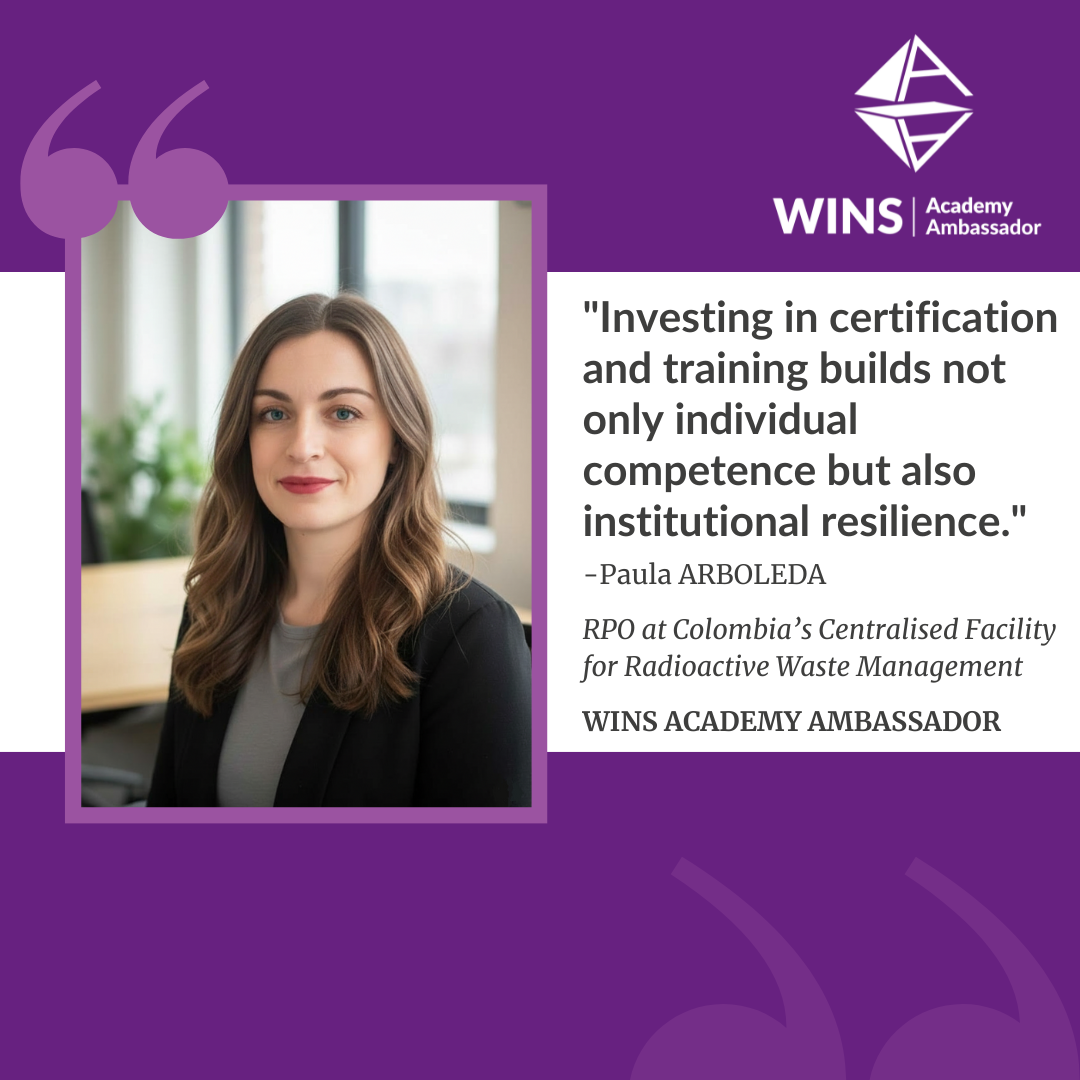
Paula Arboleda is Radiation Protection Officer at the centralised facility for radioactive waste management in Colombia. With a strong commitment to capacity building and dissemination of knowledge, she has recently taken on the role of WINS Academy Ambassador.
In this interview, she spoke about the fundamental role of a technically competent workforce in supporting security systems, the contribution of training to organisational resilience, and the importance of international cooperation and knowledge exchange. She also shared her own experience applying the strategies from the Radioactive Source Security Management module in her own work.
How has your technical background shaped your perspective on radioactive source security and risk management?
My technical background in engineering sciences, together with my current role as a Radiation Protection Officer and operator in a centralised radioactive waste management facility, has shaped a strongly operational and lifecycle-based perspective on radioactive source security. My work involves the hands-on management of disused radioactive sources, including their characterisation, safe storage, transport, and regulatory compliance, which has highlighted the close interdependence between safety, security, and operational decision making.
Working in a context with evolving infrastructure and resource constraints has further reinforced the importance of risk management approaches that are practical, proportionate, and adaptable to local conditions, while remaining aligned with international good practices. Effective security, in my experience, is achieved when it is embedded in daily operations and supported by technically competent personnel who understand both the risks and the operational context in which they arise.
How does international knowledge exchange help practitioners address key considerations such as managing radioactive source security across its lifecycle?
International knowledge exchange allows practitioners to learn from real operational experience beyond their national context. Sharing lessons learned, challenges, and solutions helps identify common vulnerabilities and effective mitigation measures across the full lifecycle of radioactive sources. These exchanges also promote the harmonisation of approaches, strengthen professional judgement, and support countries with limited infrastructure by providing access to proven practices and expert networks.
“Access to high-quality training, mentorship, and professional networks can significantly improve security practices.”
How does the WINS Academy help practitioners strengthen their security performance? How has your own experience with the Radioactive Source Security Management Certification Programme influenced your day-to-day work?
The WINS Academy strengthens practitioners’ security performance by providing structured training that directly connects security concepts with real operational contexts. The Radioactive Source Security Management Certification Programme enhanced my ability to apply a systematic, risk-informed approach to radioactive source security, particularly for disused sources managed in centralised storage facilities and during transport operations. Through the programme, I strengthened my capacity to identify vulnerabilities, define proportionate protection measures, and clearly document the technical, operational, and security basis for decisions across the source lifecycle.
In my day-to-day work, this has resulted in more robust and auditable procedures; improved coordination between radiation protection, security, and operational teams; and clearer technical justification of security measures during inspections and regulatory audits. It has also supported more effective preparation for transport activities, including route planning, interface management, and documentation, ensuring that security considerations are consistently integrated into operational planning and routine activities.
How does investing in certification and training ultimately contribute to stronger organisational and global radioactive source security?
Investing in certification and training builds not only individual competence but also institutional resilience. Practical experience, combined with continuous professional development, allows personnel to anticipate, identify, and mitigate risks effectively. While robust infrastructure, reliable equipment, and well-maintained security systems are essential, human capital — the knowledge, judgment, and operational expertise of trained staff— is equally critical for ensuring strong security performance. At the global level, a workforce that is both experienced and continuously updated fosters consistency, trust, and cooperation across institutions and countries, which is indispensable for effective and sustainable radioactive source security.
“Investing in certification and training builds not only individual competence but also institutional resilience.”
What inspired you to become a WINS Academy Ambassador?
I was inspired to become a WINS Academy Ambassador because I deeply value capacity building and the dissemination of knowledge, particularly in developing countries. My hands-on experience in radioactive source management has shown me how access to high-quality training, mentorship, and professional networks can significantly improve security practices and institutional confidence. I am also keen to further enhance my leadership skills and to connect this role with my experience as a trainer and as a leader in nuclear knowledge management within the current governance of Women in Nuclear Colombia. The Ambassador role offers a meaningful opportunity to share practical, operational experience and to promote training programmes that are directly applicable to real-world challenges. I am motivated to act as a knowledge multiplier mentoring colleagues, promoting continuous learning, and fostering resilient and interconnected professional communities.