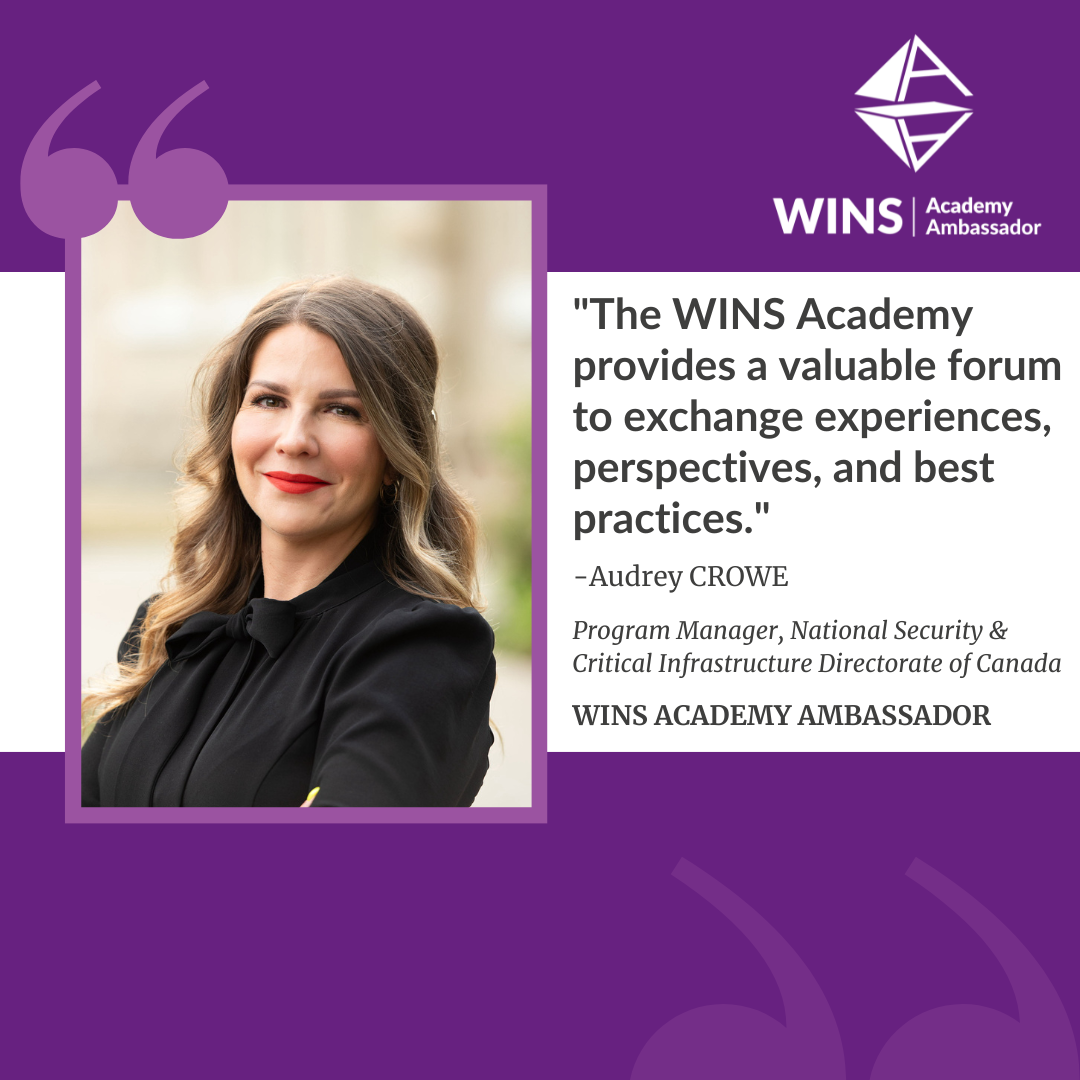
Our newest WINS Academy Ambassador, Audrey Crowe, is Program Manager within the National Security & Critical Infrastructure Directorate in Canada. In this interview, she shares insights into her career journey, the importance of building a strong nuclear security culture, the value of professional certification through the WINS Academy, and how international collaboration is helping shape the future of nuclear security.
Can you tell us about your current role as Program Manager within the National Security & Critical Infrastructure Directorate and your career path in nuclear security?
My career path in nuclear security has been somewhat unconventional. I have always been drawn to high-risk, high-consequence environments, which first led me to serve in the Canadian Armed Forces before transitioning to the nuclear sector. Since joining the nuclear industry, I have primarily held project and programme management roles. I initially viewed my non-technical educational background as a disadvantage. Over time, however, I realised it was a great strength. In these roles, I have often found myself bridging the gap between technical experts and business leaders, helping turn complex technical challenges into strategic and operational decisions.
Throughout my career, I have had the opportunity to lead diverse, multidisciplinary teams in the planning, execution, and delivery of projects and programmes that support the safety, security and resilience of Canada’s nuclear sector. In my current role as Program Manager within the National Security & Critical Infrastructure Directorate, I work alongside an exceptional team of researchers, scientists, technologists and project management professionals who share a common objective: enhancing nuclear safety and security globally. I oversee the planning, execution and strategic growth of Canada’s largest nuclear safety and security research programme. Our team delivers evidence-based solutions to current and emerging threats through research in six key areas: nuclear detection, nuclear forensics, safeguards, emergency preparedness, response and recovery, biodosimetry and medical countermeasures, and cyber resilience.
I am also a strong believer in continuous learning and professional growth. After nearly a decade in nuclear project and programme management and noticing recurring security challenges facing the global nuclear sector, I have decided to expand beyond programme delivery and into research. I am currently pursuing my doctoral studies at Delft University of Technology, where my research efforts focus on addressing insider threats in the nuclear sector and integrating nuclear security more effectively across the enterprise.
What strategies or best practices are most effective in building a strong nuclear security culture that mitigates insider risks?
I believe that a strong nuclear security culture is built on genuine care and concern for our colleagues, putting human safety and security at the centre of our programmes, rather than focusing on regulatory compliance and business performance. This approach supports the implementation of measures that are both effective and perceived as fair.
Another key element is awareness. Threat awareness and self-awareness are some of the most powerful tools we have because they drive behaviour change. This requires open, transparent and frequent communications from leadership regarding the threat landscape, how it affects our sector, our team members and why security measures matter. It’s also important to help colleagues understand how they can unintentionally become a vector for attack. Threat actors most often exploit normal human behaviour through mistakes, social engineering, personal vulnerabilities, or external pressures. Building this self-awareness empowers our team members to recognise risks and become active contributors to security.
Finally, we need to continually reinforce the importance of our mission. When you’ve worked in the sector for a long time, it’s easy to forget how attractive nuclear organisations can be to adversaries and how significant the consequences of a security incident could be. Keeping that perspective in mind helps maintain vigilance and supports a shared sense of responsibility within our organisations.
“Threat awareness and self-awareness are some of the most powerful tools we have because they drive behaviour change.”
What motivated you to pursue WINS Academy certification, and how does it align with your work in nuclear security?
I pursued the WINS Academy certification to build on my understanding of the international nuclear security landscape and to learn from other nuclear security professionals. Given that the challenges we face are increasingly global in nature, the WINS Academy provides a valuable forum to exchange experiences, perspectives, and best practices with practitioners from different countries, organisations, and areas of expertise.
In a field that spans technical, human, and organisational factors, how important is professional certification?
Professional certifications are particularly important because, although we work in a field that places significant value on technology and technical measures, effective nuclear security extends far beyond that.
The WINS certifications provide a common foundation of knowledge and encourage continuous learning across disciplines. They also offer a flexible way for security and non-security professionals to broaden their perspectives, stay current with best practices, and strengthen their ability to address complex security challenges.
“The WINS certifications provide a common foundation of knowledge and encourage continuous learning across disciplines.”
How has connecting with WINS’ international network of professionals enriched your work?
Connecting with WINS’ international network has broadened my perspective on nuclear security. It’s helped me learn from other professionals and provided opportunities to share ideas and gain practical insights that I can apply directly to my work.