As Security Design Manager at EDF Energy, Iain Burns works at the intersection of physical protection, technology integration, and operational response within the nuclear sector. With experience spanning newbuild nuclear projects, security-by-design principles, and the evolving challenges posed by emerging threats such as drones and cyber risks, he plays a key role in ensuring security remains both resilient and adaptable from the earliest stages of facility development.
In this interview, Iain discusses how layered security strategies are integrated into modern nuclear infrastructure; the importance of balancing safety, cost, and operational effectiveness; and how international collaboration and professional development through WINS and the WINS Academy support both individual practitioners and the wider industry.
Your work spans building design, technical systems, and armed response strategies; how do these elements come together to strengthen nuclear security?
In a newbuild nuclear project, security must be carefully designed in from the outset, ensuring it is correct and flexible enough to be futureproof. Building design, technical systems, and armed response are interdependent and must be developed as a single, integrated system. Ultimately, the strength comes from layered defence (defence in depth): Design slows and channels adversaries, technology detects and assesses, and response forces neutralise threats – all aligned under a unified security strategy.
What are the key security considerations when designing facilities from the ground up in newbuild projects?
Safety, cost and schedule are key when involved in building a newbuild nuclear facility (safety being very much at the forefront). They are hugely expensive projects that can easily overrun on both cost and schedule due to a myriad of reasons, and security need to remain flexible throughout. There are a good number of other considerations that take place within security design, and it is always a careful balancing to ensure the correct standard of security is implemented without injecting unnecessary cost or barriers into the project. This includes the following:
- Security by Design: Embedding protective features into the plant layout, including zoning, barriers and protected areas, futureproofing rather than retrofitting later
- Defence in Depth: Multiple layers of physical and technical protection to detect, delay and respond to threats
- Safety-Security Interface: Ensuring security measures do not compromise nuclear safety systems (Access restrictions must not impede emergency response.)
- Future Threat Adaptability: Designing infrastructure that can evolve with emerging threats (drones, autonomous systems)
Insider threat mitigation and cyber integration are also large considerations that physical security need to work closely alongside other departments to mitigate.
“[The WINS Academy] has broadened my perspective beyond site-specific challenges to global best practices.”
How has the WINS Academy complemented your technical and operational experience in nuclear security?
I completed the WINS foundation course when I entered the industry and have followed up with various electives along the way. Essentially it has broadened my perspective beyond site-specific challenges to global best practices. It has also strengthened my understanding of security culture, governance and leadership.
How does WINS certification support professionals working in highly technical and design-focused roles like yours?
There is a good amount of WINS content that, in conjunction with other courses, helps to enhance your knowledge base. I found the Cyber OT course very important in understanding the risk but also the robustness of systems we have at our power stations.
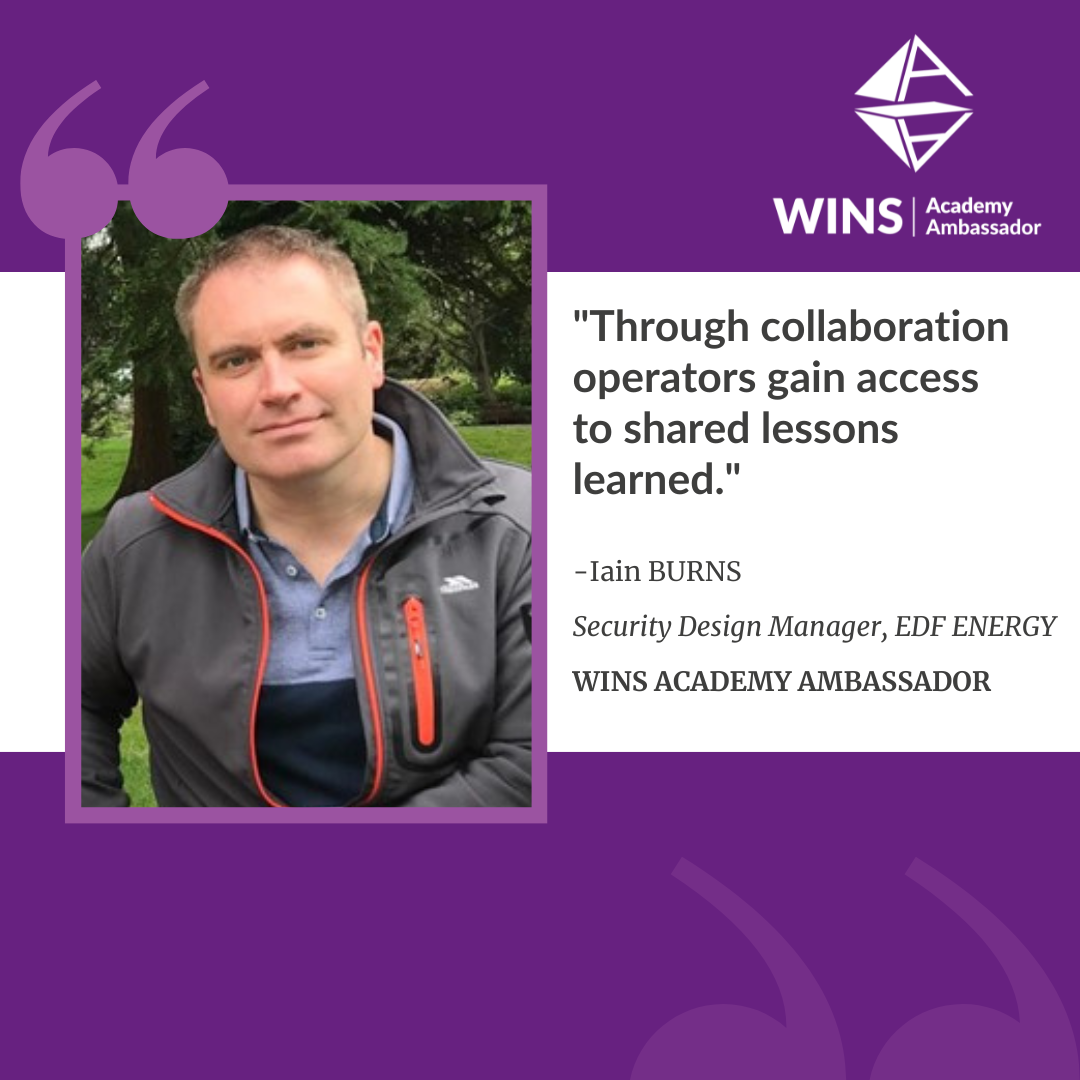
“Through collaboration operators gain access to shared lessons learned.”
How important is international collaboration through organisations such as WINS in addressing emerging threats such as drone technologies?
International collaboration is essential. Threats like drone technologies evolve rapidly and do not respect national boundaries, so no single organisation or country has a complete solution, and it is hugely useful to be able to discuss different approaches.
Through collaboration operators gain access to shared lessons learned and emerging threat intelligence, and best practices for detection, mitigation, and response can be developed more quickly.
From EDF Energy:
“Gaining and maintaining CNSP allows organisations to demonstrate they have Suitable Qualified and Experienced Persons.”
How has Iain becoming a Certified Nuclear Security Professional benefitted the organisation?
Gaining and maintaining CNSP allows organisations to demonstrate they have Suitable Qualified and Experienced Persons (SQEP) that are also current.
What role does WINS certification play in the organisation’s professional development programme?
We ask that all our graduates joining the security department undertake a WINS foundation course as a minimum. They then have the option of expanding their knowledge in an area of interest to them, which of course is broad.