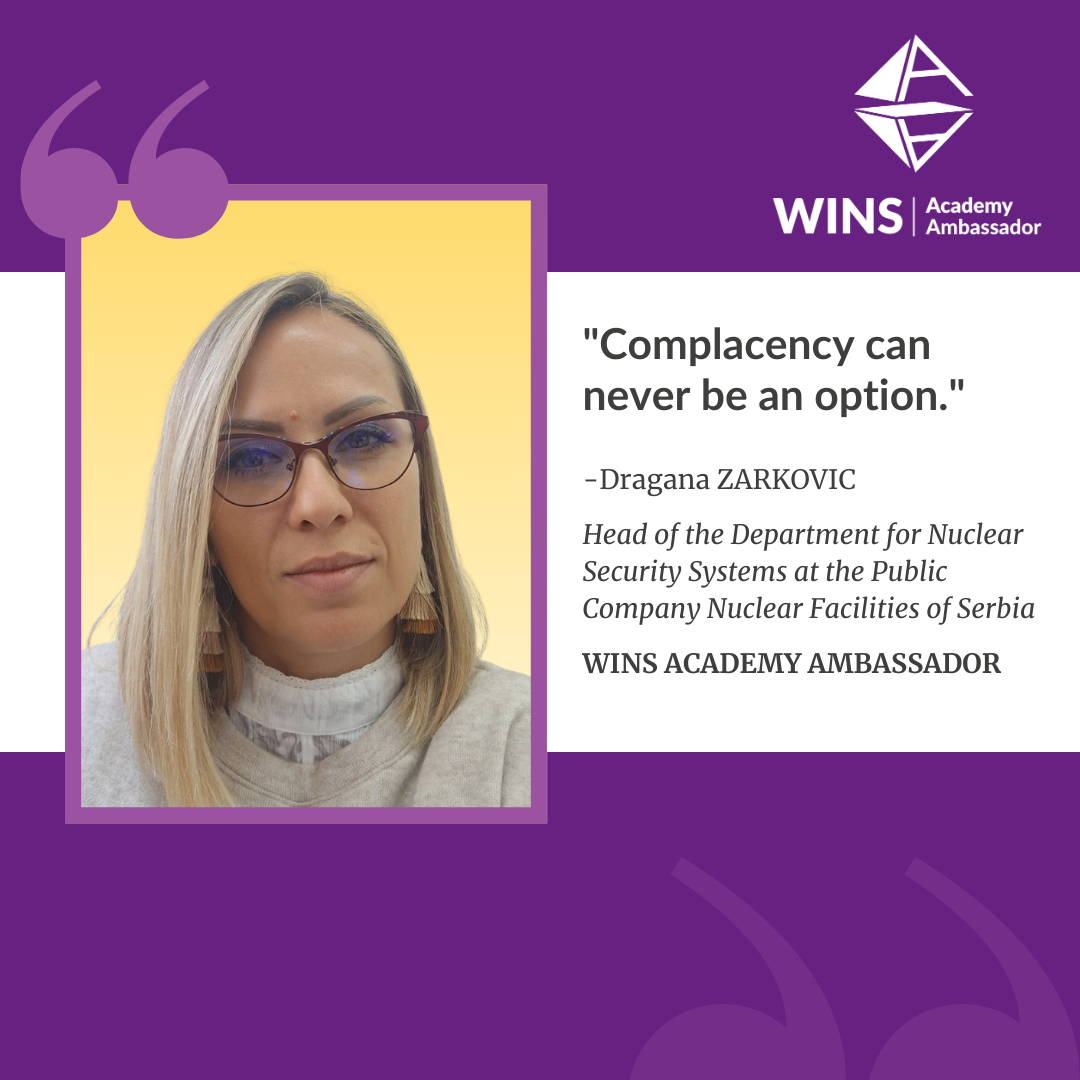
Dragana Zarkovic is Head of the Department for Nuclear Security Systems at the Public Company Nuclear Facilities of Serbia.
As the newest WINS Academy Ambassador, she explains how the WINS Academy programme provided a solid foundation to transition from safety to security – as well as the importance of international knowledge sharing to resilient and adaptable nuclear security systems.
How did the WINS Academy programme help you transition from a research role into nuclear security?
My first comprehensive introduction to nuclear security was through the WINS Academy. When I applied for WINS certification, I entered a comprehensive learning process that introduced me to the fundamental methodologies, principles, and terminology of nuclear security – areas that were new to me at the time, as my professional background had been primarily focused on nuclear safety.
The WINS Academy programme provided a clear and systematic framework that helped me understand the distinct yet complementary relationship between safety and security. It enabled me to shift from a predominantly safety-oriented perspective to a security-focused mindset, including threat assessment, risk-informed decision-making, and the application of defence-in-depth principles.
Through this process, I gained not only technical knowledge but also the confidence to actively engage in nuclear security matters, which significantly supported my successful transition from a research role into the field of nuclear security.
“I gained not only technical knowledge but also the confidence to actively engage in nuclear security matters.”
In what ways did becoming a Certified Nuclear Security Professional support your career progression into a leadership role?
Becoming a Certified Nuclear Security Professional significantly strengthened my professional credibility within the organisation. It demonstrated that my competencies in nuclear security were aligned with internationally recognised standards, recommendations, and best practices. This external validation was particularly important as I was transitioning into a field that requires a high level of trust, responsibility, and professional judgement.
However, the real value of WINS certification became most evident in practice. By applying WINS methodologies and principles in my daily work — from developing procedures and conducting risk assessments to improving security measures — I was able to transform theoretical knowledge into practical solutions. This not only reinforced my expertise but also increased my confidence in decision-making and strategic planning, which naturally supported my progression into a leadership role.
As Head of the Department for Nuclear Security Systems, how do you approach designing and implementing a comprehensive nuclear security system in an evolving risk environment?
I follow a structured, risk-informed, and adaptive framework to the design and implementation of a nuclear security system.
A key element of my approach is continuous assessment and improvement. We regularly review, upgrade, and modernise our security systems to respond to evolving threats, technological advancements, and changing risk scenarios. This ensures that protection measures remain effective, reliable, and aligned with international best practices.
Equally important is ensuring that security measures support operational continuity. I work closely with other departments to balance security requirements with safety, operational efficiency, and regulatory compliance. Open communication and cross-functional cooperation are essential for sustainable and practical implementation.
Finally, I consider adaptability a core feature of any effective security system. Regular reviews, performance testing, training, and the integration of lessons learned – both nationally and through international engagement – enable us to continuously enhance resilience and respond effectively to emerging risks.
“Becoming a Certified Nuclear Security Professional significantly strengthened my professional credibility. […] However, the real value of WINS certification became most evident in practice.”
What principles guide your decision making when balancing operational continuity and security requirements?
My decision making is guided by several key principles. First, I apply a risk-informed and graded approach. Security measures must be proportionate to the level of risk and potential consequences, ensuring effective resource allocation while maintaining safe and uninterrupted operations.
Second, I rely on the principle of defence in depth. Layered and well-integrated protection measures ensure that security does not depend on a single system and allow operational processes to function efficiently without compromising overall resilience.
Another essential principle is the integration of safety and security. In nuclear facilities, these areas must be complementary rather than competing priorities. I carefully evaluate decisions to ensure that strengthening security does not adversely affect safety or operational reliability.
Finally, transparency, communication, and collaboration are crucial. Close coordination with operational teams helps identify practical and sustainable solutions, allowing security to function as an enabling factor rather than an obstacle to operations.
How do you foster a strong security culture within your team?
I foster a strong security culture by leading by example and consistently emphasising that security is a shared responsibility, not merely a regulatory requirement.
First, I ensure that expectations, roles, and responsibilities are clearly defined and well understood. Beyond compliance, I emphasise individual accountability, professional integrity, and vigilance in the protection of nuclear and radioactive material.
Continuous education and training are also essential. I encourage participation in training programmes, exercises, and discussions on lessons learned, so that team members understand not only what measures are implemented, but why they are necessary.
Open communication is another key element. I promote an environment where staff feel comfortable reporting concerns, identifying weaknesses, and proposing improvements without hesitation. A questioning attitude strengthens resilience and helps prevent complacency.
Finally, I actively support professional development, including certifications, international engagement, and knowledge exchange, reinforcing the understanding that security excellence is a continuous process.
How has engaging with international peers through WINS strengthened your approach to security systems?
Engaging with international peers through WINS has significantly strengthened my approach by broadening both my technical perspective and strategic thinking.
Learning from the practical experiences of professionals from different countries – including challenges faced, lessons learned, and implemented solutions – provided valuable insights that go beyond theoretical guidance. It highlighted the importance of adaptability and the application of good practices in diverse operational and regulatory environments.
Most importantly, this exchange reinforced the critical importance of vigilance in nuclear security. Threats evolve, circumstances change, and complacency can never be an option. Continuous awareness, learning from experience, and readiness to adapt are essential for maintaining an effective, resilient, and sustainable nuclear security system.